300+ Conversions: Marketers, Choose the Right Attribution Model
How marketers pick an attribution model: match objective, sales cycle, channels and conversion volume. Includes GA4, Google Ads checkpoints.

300+ Conversions: Marketers, Choose the Right Attribution Model
If you’re closing 300 or more conversions a month with clean tracking, use data-driven attribution and stop second-guessing it. Below that volume, pick a rule-based fallback that matches your objective: position-based for full-funnel visibility, last-click for short, closing-focused funnels. Before you touch any settings, pull your last 90 days of monthly conversion counts and write down the one decision this model needs to support.
TL;DR:
- Use data-driven attribution if your account generates at least 300 conversions per month to ensure reliability and accuracy.
- For accounts with 100 to 300 conversions, rule-based models like linear or position-based provide a practical and explainable alternative.
- Under 100 conversions monthly, stick with simple models such as last-click because the algorithm lacks enough data for meaningful patterns.
- Match your attribution model to your sales cycle length; short cycles suit last-click or time-decay, while longer cycles require position-based or data-driven approaches.
- Always verify conversion volume before changing models, and review the impact on CPA and ROAS in comparison reports to avoid misleading bidding signals.
Table of Contents
- Attribution model options: what each one actually does
- How do you match your business to the right model?
- What conversion volume does data-driven attribution need?
- Where do you actually change the attribution model?
- Common pitfalls and when to switch models
- Where Paid Lens and Shraddha’s research fit in
- The gap between attribution theory and attribution practice
- Sources
- FAQ
Attribution model options: what each one actually does
Every attribution model answers the same question differently: which touchpoint gets credit when someone converts? The differences sound academic until you realize they can shift your reported channel performance significantly without a single dollar of media actually moving.
Last-click gives 100% of the credit to the final touchpoint before conversion. It’s the oldest model, the simplest to explain, and it systematically overweights bottom-funnel channels like branded search and retargeting while starving anything that plants the first seed. It’s still the right call for short sales cycles where the last touch really is the deciding factor, like a flash-sale email or a cart-abandonment ad.
First-click flips that logic, crediting whoever started the journey. It’s useful when you’re specifically evaluating awareness or top-of-funnel spend, but it has the same flaw in reverse: it makes prospecting channels look better than they might actually be at driving revenue.
Linear splits credit evenly across every touchpoint in the path. It’s fair in a mathematical sense, but that fairness is also its weakness. A single retargeting impression gets the same weight as the campaign that generated genuine interest, which flattens out the signal you actually need.
Time-decay weights recent touchpoints more heavily than earlier ones, typically using a exponential curve. Some Google products apply a 7-day half-life by default, meaning a touchpoint from a week before conversion carries half the weight of one from the day before. It works well for moderate-length sales cycles where recency matters but you don’t want to ignore the top of funnel entirely.
Position-based (sometimes called U-shaped) assigns 40% of credit to the first touch, 40% to the last, and splits the remaining 20% across everything in between. This is the model most marketing professionals reach for when they want to protect both awareness and closing channels from being undervalued.
Data-driven attribution (DDA) uses machine learning to analyze your actual conversion paths and assigns credit based on which touchpoints statistically correlate with conversions. It’s the industry default in Google Ads and GA4, and it adapts to your specific account rather than applying a fixed rule.
A few practical notes on where these stand today:
- Rule-based models (last-click, first-click, linear, time-decay, position-based) are all still available and documented in Search Ads 360, even as platforms push DDA as the default.
- GA4 has quietly deprecated several last-touch and first-touch reporting views in favor of data-driven as the standard, though comparison reports still let you view rule-based models for context.
- Custom models exist mostly inside dedicated analytics platforms or a tool like Markov chain attribution, which models conversion paths probabilistically rather than applying a fixed weighting rule.
How do you match your business to the right model?
Adobe’s guidance on this is blunt: there’s no universal answer, and the right model depends entirely on your specific use case, including your sales cycle, channel mix, and how much offline activity feeds into your funnel. That means the decision starts with a question, not a model name.
- Name the decision this model has to support. Are you defending upper-funnel budget against a CFO who only sees last-click numbers? Are you optimizing bids for a fast-closing product? The model you need for “prove awareness spend works” is different from the model you need for “which ad set should get more budget tomorrow.”
- Map your sales cycle to a model family. A same-day or same-week purchase (most e-commerce) tolerates last-click or time-decay just fine, since the window between first touch and conversion is short enough that the bias barely matters. A 60 to 90-day B2B cycle with five or six touchpoints needs position-based or data-driven, because last-click will make your top-of-funnel content look worthless even when it’s generating the pipeline.
- Count your channels and check for fragmentation. If you’re running search, social, display, email, and affiliate simultaneously, a simple model will misrepresent at least two or three of them. More channels generally push you toward a multitouch or data-driven approach, not a single-touch one.
- Test whether your team can explain the model in one sentence. If your sales leadership can’t understand why a channel is getting 22.7% credit under a probabilistic model, they won’t trust the reporting, and they’ll quietly revert to gut calls. Rule-based models remain valuable specifically because they’re deterministic and explainable to non-technical stakeholders.
- Check your conversion volume before you commit. This is the step most teams skip, and it’s the one that actually gates whether data-driven attribution will work at all.
- Pick, document, and set a review date. Write down why you chose the model, not just which one you chose. That documentation is what saves you when someone asks in six months why Facebook’s numbers “dropped.”
Adobe also makes a point worth repeating here: don’t let a measurement debate freeze budget decisions. Pick a defensible model, act on it, and revisit the choice on a schedule rather than every time a stakeholder disputes a number.
What conversion volume does data-driven attribution need?
Data-driven attribution needs enough conversions to find real statistical patterns. Below a certain threshold, the algorithm has nothing to learn from, and Google Ads will automatically fall back to a simpler model when your account doesn’t have sufficient data.
Pro Tip: Don’t wait for a platform warning to tell you your data is thin. Check your monthly conversion count first. It’s the fastest diagnostic you have.
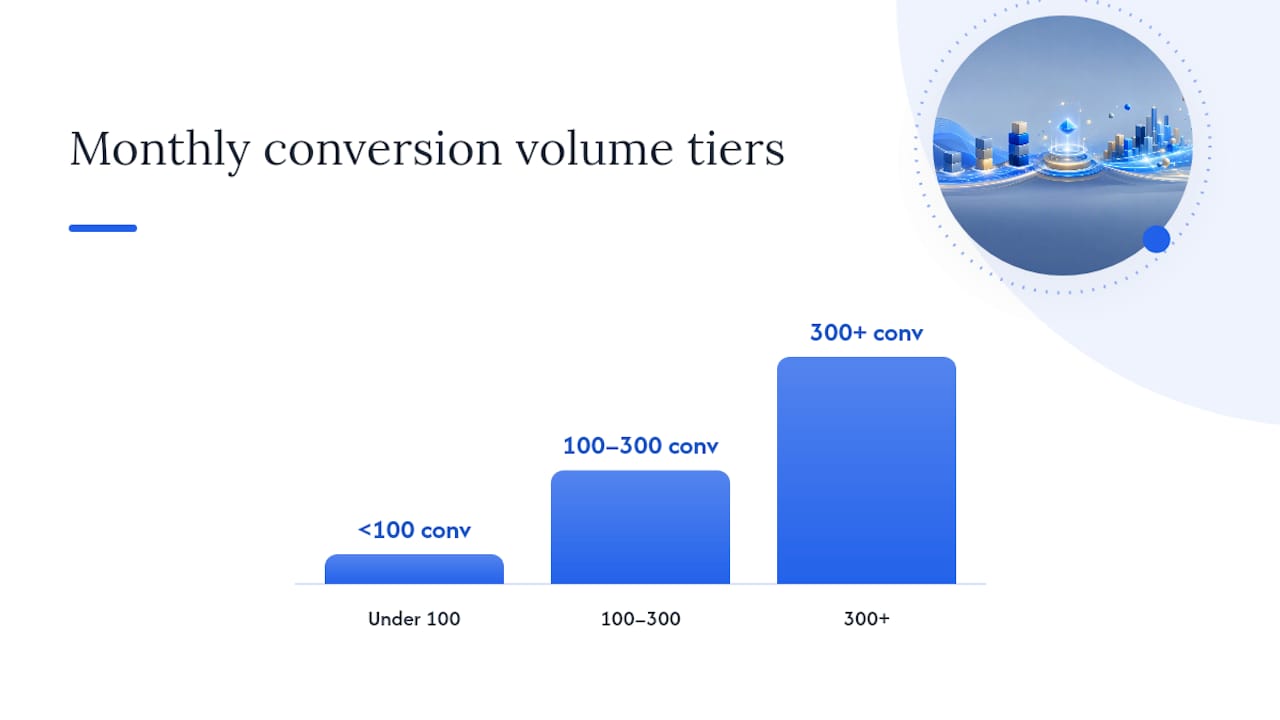
A workable rule of thumb from Conversion Studio’s analysis breaks down like this:
- Under 100 monthly conversions: stick with last-click or another simple rule. There isn’t enough volume for multi-touch modeling to say anything reliable.
- 100 to 300 monthly conversions: rule-based multi-touch models like linear or position-based are the sweet spot.
- 300+ monthly conversions: data-driven attribution becomes statistically viable and generally outperforms fixed rules.
Volume alone won’t save a messy account. Run through this before trusting any model’s output: consistent UTM tagging across every campaign, cross-device identity resolution if a meaningful share of your traffic switches devices mid-journey, a working CRM connection so revenue data reconciles with ad platform conversions, and deduplicated conversion events so one purchase isn’t counted twice across platforms.
Where do you actually change the attribution model?
In GA4, attribution settings live under Admin, and the platform gives you model comparison reports that let you view the same conversion data under different models side by side before you change anything downstream. Google Ads has a parallel settings path inside each conversion action.
- Open the model comparison report first, before touching live settings, and note how CPA and ROAS shift by channel under each model.
- Set your lookback window to match reality: roughly 30 days for most e-commerce purchases and 60 to 90 days for B2B, since a shorter window will simply drop legitimate upper-funnel touchpoints from the picture.
- Confirm conversion definitions match across GA4, Google Ads, and any CRM you’re piping revenue from, since mismatched definitions make every downstream comparison meaningless.
- Only after you’ve quantified the CPA/ROAS shift should you adjust bid strategies, since automated bidding reads directly from your conversion columns.
A quiet risk here: changing your attribution model changes the conversion values your automated bidding algorithms optimize toward. Google explicitly flags that attribution changes affect the columns bid strategies rely on, so a model switch without a monitoring period can send Smart Bidding chasing a different, and possibly worse, set of signals.
Common pitfalls and when to switch models
The three mistakes that show up most often: relying on a single model with no comparison view, keeping ad platform data siloed from CRM revenue, and treating “assisted conversions” as proof a channel drove the sale rather than just touched it somewhere along the way.
No model, including data-driven attribution, is fully causal on its own. The strongest validation approach combines attribution with incrementality testing and media-mix modeling to confirm the credit a model assigns actually reflects real impact, not just correlation. Reconciling attributed revenue against your CRM’s closed-won numbers on a monthly basis catches drift early.
Reassess your model when conversion volume crosses one of the thresholds above, when you add or drop a major channel, or when sales cycle length shifts by more than a few weeks. A quarterly review is a reasonable default cadence for most accounts.
Where Paid Lens and Shraddha’s research fit in
Paid Lens validates cross-platform data quality and ranks optimization actions by expected impact, which matters once your attribution model is set but you still need to know what to act on. Shraddha’s writing on Markov attribution and LTV-to-CAC ratios digs deeper into the advanced methods this guide only outlines. Manual validation still works fine for smaller accounts; the case for a decision-intelligence layer grows with your channel count and data volume.
The gap between attribution theory and attribution practice
Most attribution content treats model selection like a one-time technical decision. It isn’t. The model you pick is really a statement about what your team is willing to defend in a budget meeting, and that changes as your conversion volume, channel mix, and stakeholder makeup change.
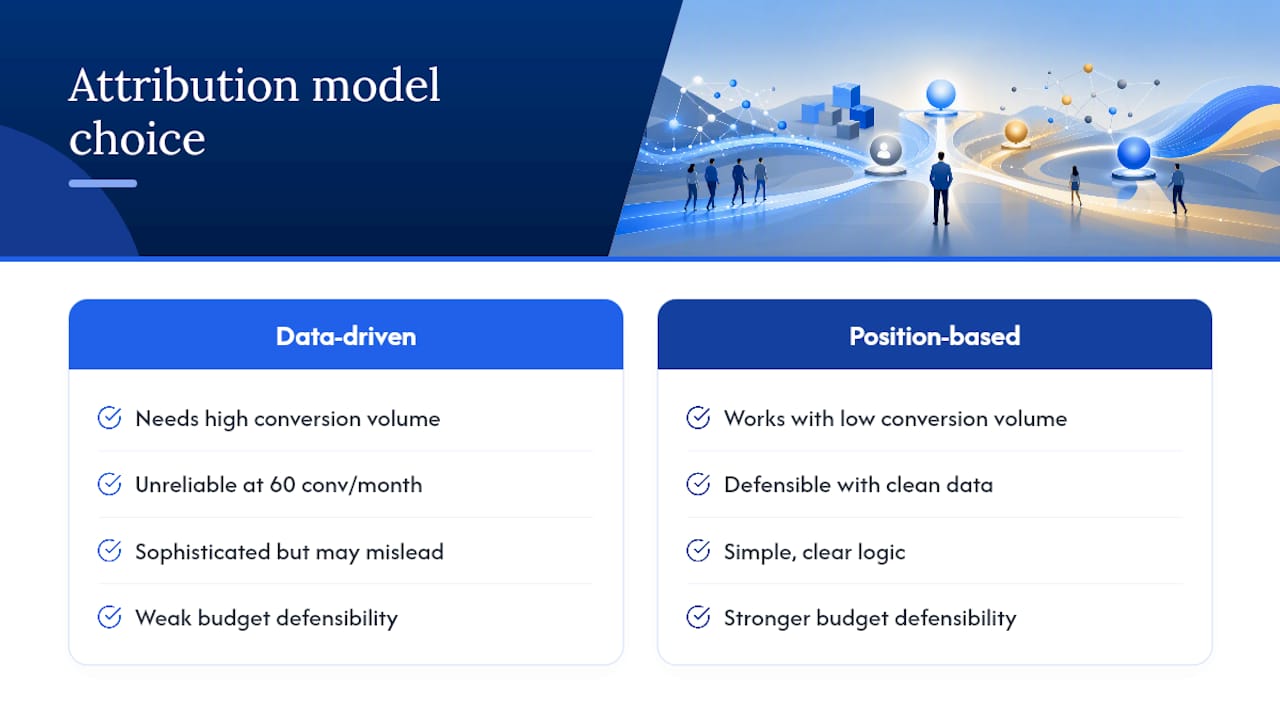
The conventional advice, “just use data-driven, it’s the most advanced,” ignores that advanced doesn’t mean trustworthy at low volume. A data-driven model built on 60 noisy conversions a month will confidently hand you a wrong answer. A position-based model built on clean data and clear logic will hand you a defensible one. Defensible beats sophisticated more often than most marketing teams admit.
If there’s one priority to take from this: audit your conversion volume and data hygiene before you touch model selection at all. The model is the easy part. Trusting what it tells you is the actual work.
— Shraddha
Sources
- About attribution models - Google Ads Help
- Marketing attribution: A complete guide to attribution models. — Adobe for Business
- Marketing attribution models: which one to choose — Conversion Studio
FAQ
What Does Attribution Model Mean?
An attribution model is the rule set that decides how much credit each marketing touchpoint gets for a conversion, whether that’s a single click or a sequence of ad views, emails, and site visits across weeks.
What Are the Different Types of Attribution Models?
The main types are last-click, first-click, linear, time-decay, position-based, and data-driven attribution, with custom or algorithmic models like Markov chains available in more advanced analytics setups.
What Are the Four Types of Attribution?
Marketers often shorthand the space to four core rule-based models: last-click, first-click, linear, and position-based, though most modern platforms also offer time-decay and data-driven options beyond that basic set.
Can You Give an Example of an Attribution Model?
Position-based attribution is a common example: it assigns 40% of conversion credit to the first touchpoint, 40% to the last, and splits the remaining 20% across every touchpoint in between.
Which Attribution Model Should I Use if I Have Low Conversion Volume?
If you’re under roughly 100 monthly conversions, use last-click or another simple rule-based model, since data-driven attribution needs sufficient volume to find reliable patterns and will otherwise fall back automatically.